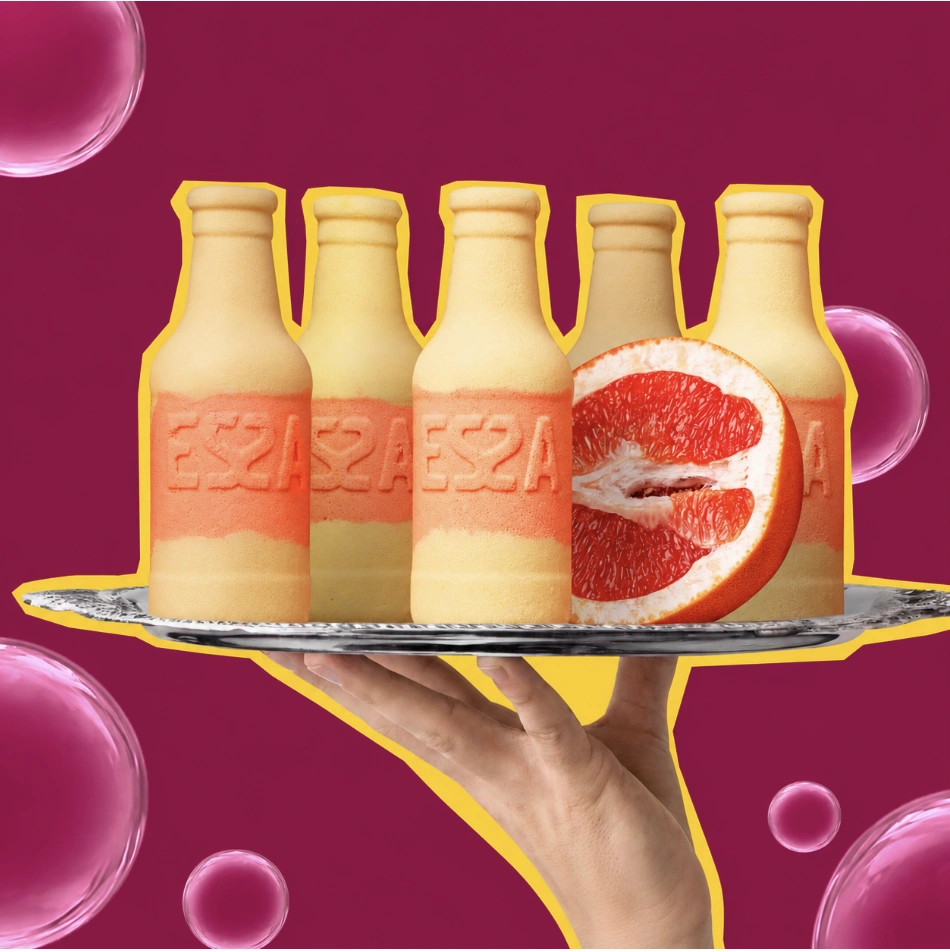
ESSA is the leader of the flavoured beer segment, with 82% awareness and 68% consideration. But in a category where new launches and SKUs migrating from RTD account for 36% of volume and drive the segment's growth (+27% MAT), a strong brand position does not guarantee that perception stays fresh. Familiarity starts working against you: the better known you are, the more ordinary you become. In 2025 ESSA had no product launch — the category's main instrument for attracting attention. At the same time, earning free attention around non-alcoholic beer is hard: neither the product nor the brand platform, "The sound of a party in every bubble," is something media or consumers will write about for free when a brand runs yet another campaign.
Problem
Overall goal: create a product that spreads organically and virally, strengthening ESSA's emotional leadership and proving the power of the platform "The sound of a party in every bubble." — Media: launch a story capable of living in the press and on social on its own, with no paid media behind its distribution. Target — at least 7M OTS and PR Value of 3M RUB or more. — Communications: generate product-born UGC and user reviews — natural triggers for conversation rather than advertising. Target — at least 100 organic publications. — Marketing: use virality to gain access to beauty media, a channel previously closed to a beer brand. Consideration +3 pp. — Business: prove demand through sell-out speed and resale on the secondary market. Target — 100% of the first run sold within a month.
Solution
Insight. For a young audience, downtime is no longer just a way to relax — it's a small personal ritual: sensory, unusual and worth sharing. But a beer brand lives in the moment of the party, not in rituals of recovery. To get there, ESSA had to stop being just a drink while keeping its party mood. Idea. We extended ESSA's mood into a place no one expects a beer brand — the bathroom. Together with Leosilverhome we created Russia's first beer bath bombs: hop extract, the shape of an ESSA bottle and the pineapple-grapefruit scent of the brand's key flavour. "The sound of a party in every bubble" became not a metaphor but a sensory experience you can buy, try, show and talk about. Why this way. Instead of reinforcing our position in familiar channels, we moved the platform into a category where ESSA had never existed. A bath bomb is literally bubbles, fizz, the switch from routine into celebration: the connection is physical, not forced. We chose the partner not for media weight but for the ability to make a genuinely good product — out of dozens of brands considered, we went with local maker Leosilverhome. The limited run of 1,000 units was part of the strategy: scarcity as a driver of virality and as proof of demand. Execution. After several months of testing, the bath bomb took the shape of a beer bottle, with hop extract, a shimmer effect in water and the scent of the key SKU. Before launch we presented the product to bloggers at a closed event, which opened the door to beauty media that had never written about ESSA. Then the drop went live through Leosilverhome's online channels: the news went viral and the run sold out in three days. With resellers marking the bombs up on Avito (Russia's largest classifieds platform), we produced a second run. The product went viral again — this time through funny marketplace reviews — generating a second wave of coverage. That run sold out too.
Results
Media: viral reach of 19,300,232 against a 7M target. 463 publications against a target of 100, including 26 in beauty media — a channel previously closed to a beer brand — among them the "new products of the month" section in print editions. PR Value of 16M RUB against a 3M target. Brand: awareness +3.8 pp, consideration +3.7 pp against a +3 pp target (Ipsos tracking HY'24–25). Product: both runs (2 × 1,000) sold out in full, the first in three days against a 30-day target. Resale on Avito, Russia's largest classifieds platform, at 2,500 RUB against a 700 RUB retail price (×3.5). ESSA Non-Alco portfolio +9% year on year. Trial grew from 55.19% to 57.32%. The project showed that virality can come not from a communications device but from the product itself — and can produce two independent waves with no paid media behind them. Search data confirms the effect held: after the second wave, interest ran 143% above the initial peak. It gives the brand a model in which the product works as media.