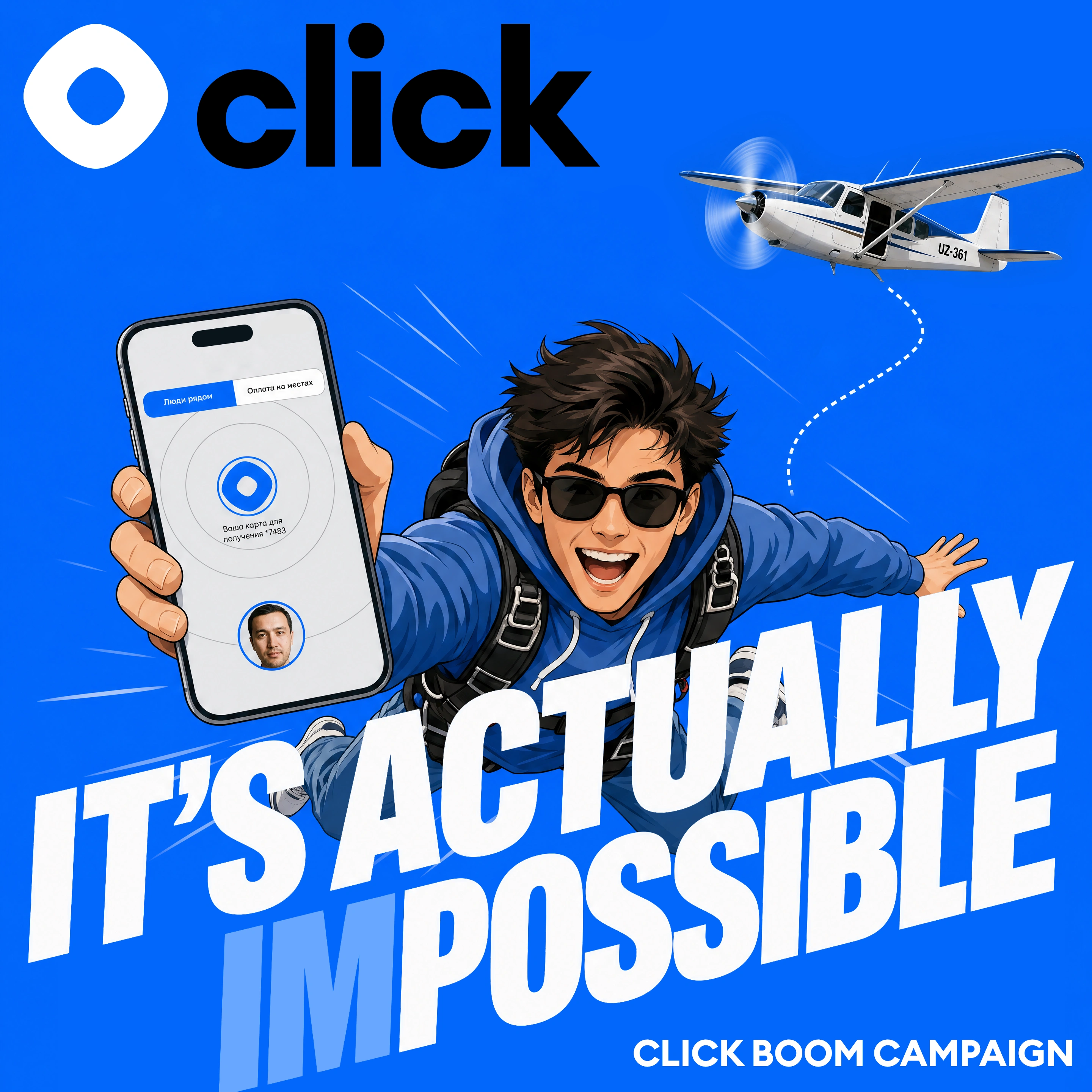
Uzbekistan is home to 38 million people, roughly 21 million of whom make up the active working-age population — a strong incentive for the growth of digital financial services, with dozens of banks and apps competing for the same audience. At the same time, mobile internet and connectivity don’t always keep pace with the growing number of users — a connection can drop at the worst possible moment. Against this backdrop, Click, Uzbekistan’s largest payment platform, launched Click Boom — a feature that lets users transfer money without a card or a phone number, over Bluetooth: all it takes is being near another person.
Problem
Despite its convenience, almost no one was using Click Boom. The problem existed on two levels: • Product level: many users didn’t know the feature existed, and those who found it inside the app didn’t understand how it worked. Click Boom remained invisible inside the product and had no impact on P2P transfer volume. • Communication level: a standard “here’s how it works” explainer wouldn’t have cut through — audiences are saturated with near-identical banking-feature announcements and wouldn’t take the claim at face value. What was needed was a story that made people doubt it and want to check for themselves.
Solution
Insight Simply telling people about a new feature isn’t enough to make them notice it — you need to create a situation that gets the audience arguing about whether the transfer itself is even possible. Once people start doubting and asking “is this real?”, they inevitably learn how Click Boom actually works. Creative idea Show what Click Boom can do as literally and as absurdly as possible: a money transfer completed mid-skydive. Campaign line: “It’s really possible.” The film was deliberately shot to look almost too real and provocative, engineered to trigger the audience’s core question: “Is this even possible?” Mechanics — two phases Phase 1. A staged film shot in a pavilion: a Bluetooth transfer, with the skydiving background added through CGI. Released across Digital, LED screens and TV. Part of the audience believed it outright; part grew suspicious and called it fake — expected, and exactly the fuel needed for Phase 2. Audience reaction. Comments filled with doubt and accusations of exaggeration, plus breakdown videos from bloggers on Telegram — the film became a talking point in its own right. Phase 2. The brand accepted the skeptics’ challenge and shot a documentary experiment (https://youtu.be/iNChv-1igaw) — a real skydive, with the Click Boom transfer completed mid-air. The first attempt failed (wind separated the jumpers); the next attempt succeeded. The failed attempt wasn’t cut from the final film — it was shown exactly as it happened, which strengthened the film’s credibility. The final film ran across every available channel: inside the Click app, Instagram, YouTube, Telegram, PR, and influencers.
Results
The campaign ran for 2 months. Media metrics: 7,904,117 — reach inside the Click app | 4,037,000 — reach from 15 bloggers | 8,500,000 — impressions on 33 LED screens | 64,000,000 — impressions on TV (8 channels) Performance metrics: 207,003 — new app installs | 704,129 — uses of Click Boom