Water is the crisis in Uzbekistan that is easiest to overlook. According to Uzsuvtaminot (July 2025), 81.5% of the population has centralised water supply — nearly one in five lives without it; by the estimates the campaign works with, up to 35% of the population has no access to clean drinking water. Over 90% of surface water is polluted, and the country consumes 169% of its renewable water resources every year.
Problem
The water crisis has no face. Murky water on screen has long since become visual noise — audiences have learned to scroll past it. And the real danger of nitrate-contaminated water is that it doesn’t look dangerous: it is clear, familiar, everyday. As long as water runs from the tap, the issue belongs to someone else — above all for the urban audience, businesses and media the project depends on. HAYOT Foundation launched Hayot Suvi, a system supplying schools, kindergartens and medical facilities in remote regions with drinking water: regular deliveries, water trucks, routes, storage tanks. What the project needed was not advertising but an emotional way in. The task: not to state the statistic but to give it a body — and to do it as a full-fledged music video that lives by the rules of content, not of a charity appeal.
Solution
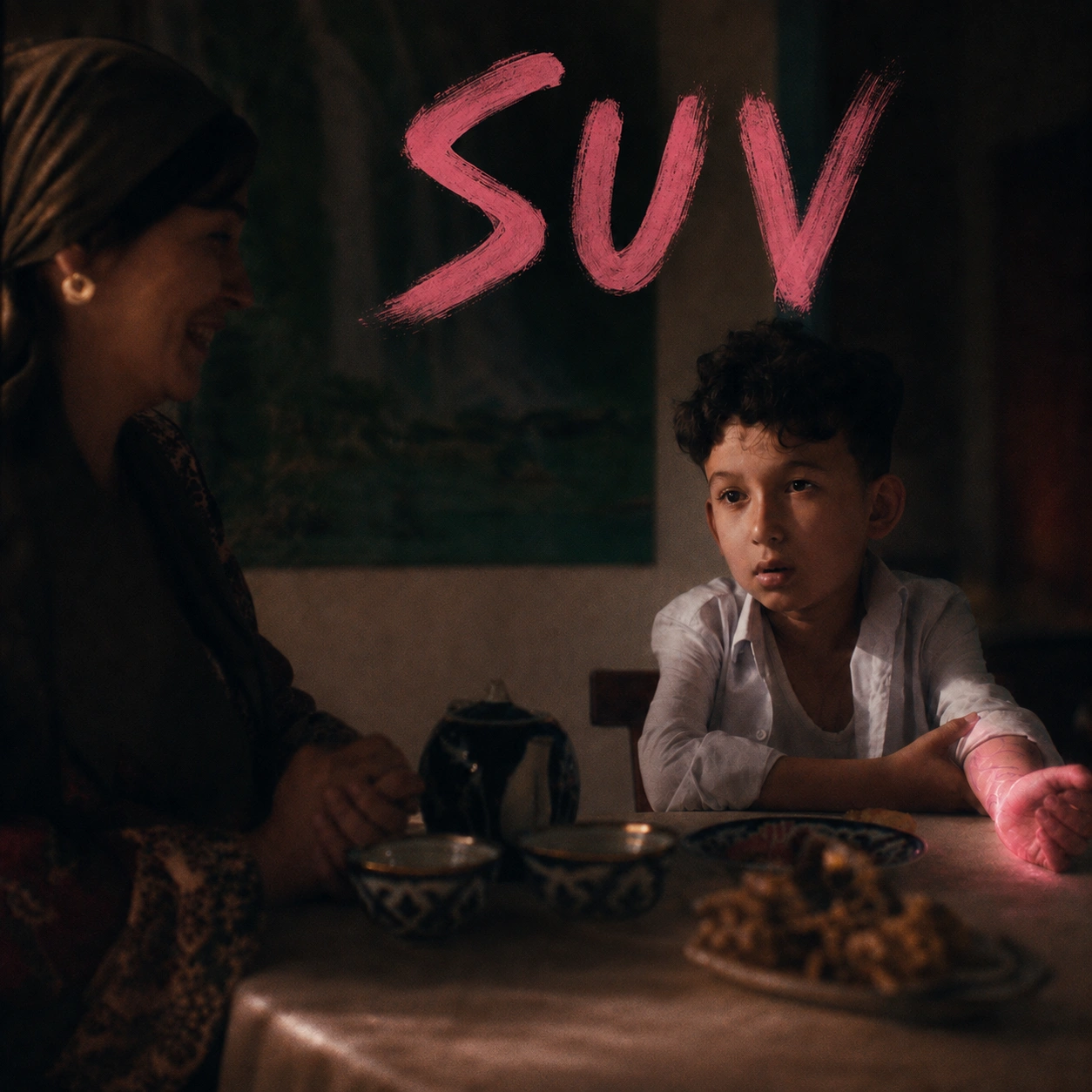
We made the invisible visible: after drinking, the boy’s skin turns blue and blooms with a pattern — beautiful enough that you admire it before you fear it. The image rests on medicine: nitrates cause methaemoglobinaemia, “blue baby syndrome”. He hides the mark in shame, then sees it on everyone — and sees that no adult minds. The anomaly turns out to be the norm. The story is told by a child from the provinces, the camera held at his height. The final image is Muynak, the rusted ships on the dry bed of the Aral Sea. Generative AI was kept to a minimum on principle: it consumes water, and a film about water scarcity cannot be made at water’s expense. The water on screen is real drinking water tinted with food-safe colouring — on a set with children, nothing that couldn’t be swallowed. Shot on Alexa, in real locations only. The entire project was made pro bono.
Results
The film was presented at the public launch of HAYOT Foundation — the announcement of the foundation itself, not of a single event. Saya Musa performed the song at project events, including abroad, and a series of offline eco-events followed the release. The work was designed as a long-term campaign asset, so its measurable impact continues to accumulate.